
Writing website copy might seem like a relatively straightforward task to the untrained eye. It’s just writing the words that go on your website, right? Except it really isn’t.
Perhaps more so than any other type of copy a business might need, website copy is a multifaceted beast that demands more than the ability to string a sentence together.
In this blog post, we’re looking at the three essential pillars that make up good website copy, and the skills that are needed to create it.
TL:DR
- Messaging: what is your value proposition?
- Structure: deciding what information goes where
- Language: what is your tone of voice?
1) Messaging: what is your value proposition?
Before you can start writing website copy, you need to know what you’re saying. Ok, that might sound a little obvious but what we mean is this: what is the one thing you want your audience to take from your website?
Let’s assume they’re not especially sold on the idea of working with or buying from you just yet. They’re having a browse, checking you out to see whether or not they’re interested. They’re going to give you 10-15 seconds tops and then they’re outta there.
What is the one hook that will keep them reading? What makes you different from your competitors? How are you going to benefit them? In other words, what’s your value proposition?
How to construct your website’s core messaging
Here’s the (very) simple version. Firstly you have to understand who you are and what you have to offer, especially anything you do differently. Then you have to understand your audience and what they need, especially any problems or ambitions they have.
Then look at where those two things overlap.
The result won’t always look the same. Core messaging isn’t a cut and dried concept. Sometimes it’s about the strapline. Other times it’s about a value proposition statement. More often it’s a sort of underlying idea that isn’t necessarily articulated directly in one central place but informs everything about your website copy.
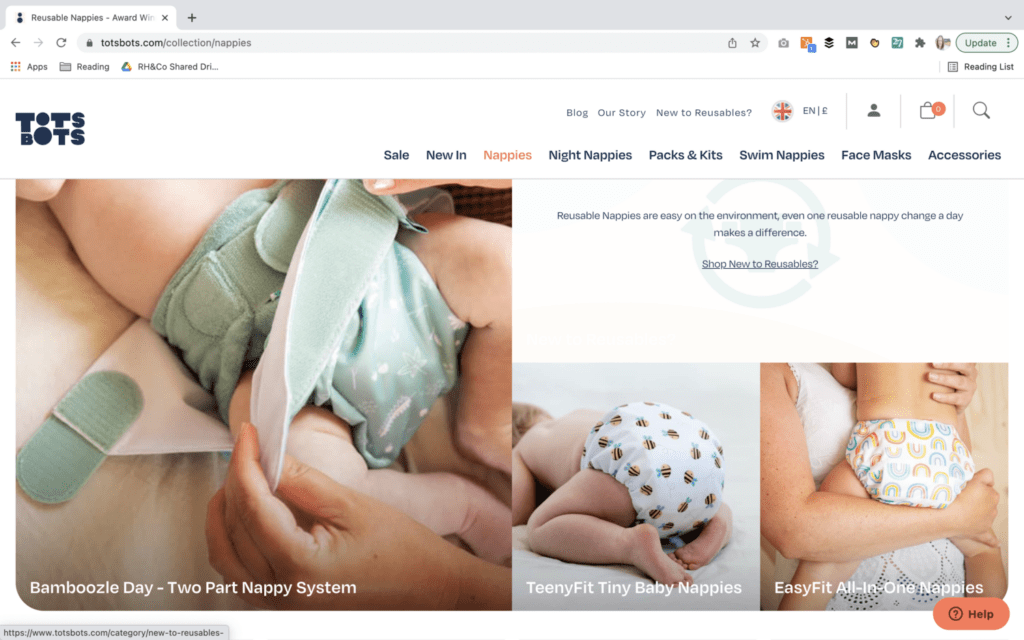
For example, we recently worked alongside London branding and design agency Mammal on a project for reusable nappy brand TotsBots.
Their core message centred around the idea that you don’t need to go fully reusable because using just one reusable nappy each day makes a huge difference to the environment. We referenced this in numerous places around the site.
A secondary message was that reusables don’t have to be as complex as you might think, and we worked hard to use language that was clear and honest throughout the site.
These messaging pillars both promoted TotsBots’ sustainable agenda and also spoke to the needs of their audience: busy parents who want to be more environmentally friendly but don’t necessarily have time to go all in and might be worried it’s all too much effort.
2) Structure: deciding what information goes where
Once you know the headlines, you need to start thinking about how you’re going to construct your website. This is where design and copywriting overlap with each other, and with UX and SEO too.
What should your overall site map look like? Will you have one services page that lists your three main services, for example, or will you have one page for each service? Or do you need to break those even further down to capture specific niche SEO keywords and phrases?
On your home page, are you going to separate your audience by product or service type or by user group? Will you have a carousel of testimonials or panels highlighting case studies that visitors can click through to read?
You also need to think about things like where your call to action (CTA) buttons go as well as what they say, how many paragraphs of text a panel can comfortably hold, whether you need to separate those paragraphs out into individual boxes and a whole host of other things.
“Brand voice is not as easy as saying “We want to sound friendly but professional.” There are many factors to take into account and they’re often fairly subjective.”
What comes first, words or layout?
This is a really interesting question and there isn’t a straightforward answer.
Sometimes our website copywriting clients will have already worked with a strategic website developer to create a sitemap and perhaps even a series of page wireframes filled with lorem ipsum. This ‘dummy copy’ gives an idea of what a page will look like once it’s done without anything having been written.
In cases like this, our job is that bit easier as we have signposts for where each element of the core information will go and can concentrate on getting the wording right (see stage three, below).
But other times a client approaches us for help with messaging and copy before they’ve made a start on the site’s wireframe and layout. In this case, before we can start working on the wording, we need to help them decide what goes where.
That’s why at RH&Co we’ve developed a way of marking up our copy with design guidelines to help the client and their designer or developer make sense of the words as we envisage them on the page.
The reality is that most projects are a mix of the two, with designer / developer and writer going back and forth to ensure the final website meets the client’s requirements by serving the visitor best.
3) Language: what is your tone of voice?
The first two pillars take a lot of work because they’re deeply strategic. But even once these have been signed off, choosing the right words to communicate your core messaging across your website’s fledgling structure takes a lot of thought.
Brand voice is not as easy as saying “We want to sound friendly but professional.” There are many factors to take into account and they’re often fairly subjective.
For example, you might want your brand to sound friendly, but what does that actually look like? Are you going to be chatty? Warm? Funny? Irreverent? Let’s say you mean chatty – chatty like who? Like a businessman being chatty with colleagues or a teenager being chatty on Snapchat?
Choosing the right language can be an incredibly granular exercise. There is a subtle difference between the words ‘simple’, ‘straightforward’ and ‘easy’, for example, and you change the personality of each by adding a qualifier like ‘super’, ‘ultra’ or ‘extremely’. So ‘super simple’ has that chatty, warm, probably B2C feel whereas extremely straightforward is that little bit more formal, possibly businesslike and suited to a B2B brand.
Going back to the Tots Bots example, we spend a fair amount of time deciding which synonyms of ‘baby’ would be appropriate for the brand. You’ll see that we decided ‘little one’ was fine but you won’t see ‘cherub’ or ‘angel’ anywhere on the site as they’re too cutesy, while ‘infant’ feels too medical.
Creating brand voice guidelines
If you have brand tone of voice guidelines, the copy creation stage of website copywriting is greatly simplified.
Brand voice guidelines usually touch on elements such as a brand’s personality and values. They might talk about the target audience and their relationship to the brand. And they might include well known examples of people who the brand voice draws on.
Most importantly, they’ll have real life examples of the way the brand voice should sound – and often how it shouldn’t. These ‘do this, not that’ copy examples are invaluable because they provide a clear, black and white marker on which to anchor what ‘chatty’ or ‘formal’ or ‘funky’ actually looks like.
Without brand voice guidelines, your website copywriter will need to use their first draft – based on everything they’ve learned from the briefing – to create their best interpretation of your brand voice in your first draft website copy.
From there, you’ll need to provide very clear and specific feedback about what aspects of the language aren’t working. General statements like ‘it feels too old fashioned’ are helpful only to a point. Your writer will need to know which words and phrases you think create that impression, as well as any that you think are closer to the mark.
Should you write your own website copy or outsource?
Unless you have an experienced website copywriter on your team, we would always recommend getting an expert involved. This could be a freelance copywriter, a copywriting agency like us, or your web developer might have the right skills in house to support you.
As you’ll have seen from the rest of this blog post, writing website copy is much more complex than simply writing in an articulate way. And we haven’t even mentioned the art of persuasive writing and the science of reading online.
If you are considering getting support to write your website copy, make sure you spend plenty of time thinking through the different elements above – messaging, structure and language – so you’ll be prepared to give accurate answers during your briefing session.
It might feel like a lot of effort but if you get this right, everything else – all of your written comms, content and marketing materials – will be that much easier to produce and, ultimately, be more effective.
If you would like to talk about your brand voice, messaging or website copy, drop us a line on talktous@rin-hamburgh.co.uk and we’d be very happy to chat about how we can support you.
Whatever copywriting project you’re embarking on – whether it’s website copy, a chunky white paper or a series of expert led blog posts – there will come a point when you need give your copywriter feedback.
You might think that in a perfect world you’d be happy with each and every word they presents in their first draft, but the reality is that the chances of this are practically zero – especially if you’re at the beginning of your working relationship. It may be the copy needs just a few tweaks that are easy enough to make, or there might be broader issues around messaging, structure or tone that you’re not 100% happy with.
So how do you give feedback in a way that will ensure that your second draft copy is that much closer to what you’re looking for? Here’s what we’ve learned over the years, from a writer’s perspective.
TL:DR
- Remember that we’re not taking it personally
- Does it meet the brief?
- Be realistic about what’s possible
- Feeding back on messaging, structure and tone
- Broad vs detailed feedback and how to deliver it
- The practicalities – tracked changes and comments
- Signing off your copy
Remember that we’re not taking it personally
This is a really important point to start with. A lot of people find giving feedback uncomfortable, as it feels like they’re being critical and that doesn’t come naturally to a lot of people. But as copywriters we expect to get guidance from our clients in terms of what’s working for them and what isn’t.
After all, writing is as much an art as a science. There’s an element of subjectivity, and what works for one person won’t always work for another. Our perceptions of what constitutes “formal” or “humorous” or “disruptive” might be different from yours.
So try to take the emotion out of it and simply be as clear as possible about what you do and don’t like so that the next draft is better. That said, positive framing is always nicer to receive than blunt negativity! Try “need something less technical here” instead of “this is way too complicated”.
“From the outset, it’s important to be realistic about what your copywriter will be able to achieve with the tools they’ve been given.”
Does it meet the brief?
Having said that you should be clear about what you do and don’t like, the main thing to consider is how well the copy meets the brief. After all, you’re not the target reader and part of why you’ve hired a copywriter or copywriting agency is to bring an outside perspective.
For example, you may have asked for a technically complex piece that still needs to be accessible to a non-technical audience. In which case, don’t be surprised if the copy is simplified and not as nuanced as you – the expert – understand it to be.
Of course, creating a good, detailed brief is part of what your copywriter or agency should be able to help you with. Ideally, work on it collaboratively and sign it off before any writing work starts so everyone is on the same page as to what good should look like.
Be realistic about what’s possible
From the outset, it’s important to be realistic about what your copywriter will be able to achieve with the tools they’ve been given.
Imagine, for example, you’re the marketing manager and your company’s subject matter expert isn’t available to come to the briefing and input their insights. Naturally your copywriter is going to have a hard time creating a unique piece of thought leadership content.
The same is true if you haven’t yet clarified your thoughts about the value proposition of your product or service. Your copywriter is going to struggle to articulate them in your first draft copy without first doing some messaging work with you.
Feeding back on messaging, structure and tone
There are three overarching elements that you can consider as you put together your feedback notes or prepare for a feedback session. By understanding the differences, you can be that bit more accurate about which elements you need your copywriter to work on.
First, messaging. If you had to summarise the point of your blog post in a few words, what would it be? What’s the key takeaway you want people to get from your website copy? If these aren’t correct, then nothing else will be so it’s important to get them right – ideally before the writing even starts.
Structure is about how the key elements of your copy are laid out. This might be the order that you tackle your main points in a blog post, the way you segment your services on your website home page, or simply how copy-heavy different elements of your white paper are.
Finally, tone is about the actual words used and the impression they give about the brand’s personality, levels of formality and so on. It’s whether you’re asking people to ‘check out our sizzling deals’ or ‘take a look at our exclusive offers’, for example.
Broad vs detailed feedback and how to deliver it
There are two general types of feedback. Broad feedback might be your overarching thought about, for example, the angle of your blog post not quite being right. Perhaps the copywriter has taken one point that you made in the briefing and built too heavily on it, skewing the overall feel of the piece.
In this case, a conversation might be the easiest way to give your amends. It’ll mean they can ask more probing questions to get to the bottom of why the first draft isn’t quite working.
But sometimes broad feedback isn’t helpful. If you think the tone is “too formal”, for example, it’s helpful to highlight words and phrases in the copy that demonstrate this, making notes in the document. As we’ve said, your understanding of what formal looks like might be different to your copywriter’s.
The practicalities – tracked changes and comments
When it comes to adding feedback into a first draft copy document, there are two different options, which we’d suggest using together. This applies for any text based document, whether you’re using Google Docs (as we do) or Word or something else.
The first is the comments function. This allows you to highlight a sentence or paragraph and say something like “too wordy” or “can we give an example here?” without having to do any rewriting. Remember that you’re paying your copywriter for a reason, so don’t do more work than you have to.
If you do want to tweak any wording yourself, use the ‘tracked changes’ function – in Google Docs this would be editing in ‘suggestion mode’. This gives your copywriter a chance to check the changes for errors and will also help them learn about your preferred style. This is particularly important if you’re building an ongoing relationship.
And if you are entering into a longer term relationship with a copywriter or copywriting agency, then highlighting what you like – as well as what you don’t – is very useful too.
Signing off your copy
Most copywriters and copywriting agencies will build in a couple of amends stages into each project as standard, depending on the size, complexity and importance of a project. By being as clear and as detailed as you can in the first round of amends, you should find that by the second round you’re down to much more minor tweaks.
If your copy is being designed in some way – for example, if you’ve commissioned a website or brochure – you might want to ask your copywriter to give the content a final once over at the design proof stage. This allows them to catch any errors that might have crept in and potentially help you adjust the length of the copy to fit the design, if that’s needed.
Once you’re completely satisfied with your copy, it’s time to sign it off officially. After this point, if you need any further changes, this will generally be seen as an additional job.
If you’re happy with how your project has gone, don’t forget to tell your copywriter or agency. It’s always nice to get positive feedback! But more importantly, they should be making notes about all the feedback they’ve received so that next time you need some support, they’ll be ready to go. The first draft of your future projects should need far less in the way of amends than the original copy did.
Recently, we wrote a blog post on why content is still king, despite it being 25 years since Bill Gates first penned the essay that inspired the saying. Sure, marketing is a fast moving industry powered by one technological advance after another. But the fundamentals that make content such a valuable tool in any marketer’s arsenal remain the same.
What has changed, as we discussed, is the competition. According to Hubspot, 70% of marketers are actively investing in content marketing, with 24% planning on increasing their spend in this area. Visit the Worldometers website and check out how many blog posts have been published today alone.
So as a marketer or business owner, how can you create content that stands out today, in 2022 and beyond?
Be genuinely valuable
This is the cornerstone of content marketing and what makes it different from advertising or any other type of marketing. It’s about giving your audience something they want or need, whether that be a thought provoking insight, a way to solve a problem, or help choosing between two similar products.
Yes, content needs to ultimately deliver a return for your business but you can’t have that in your mind when you conceive it. You have to put yourself in the shoes of your audience. What do they need? What are they trying to achieve? What are they struggling with? What will reassure them?
Be unique
What is it that you can say to your audience that is different to what your competitor might say? How can you weigh into the debate and add your voice, your experience, your knowledge, your expertise?
There is a place for foundational content that covers the basics. But even this needs to bring something unique, even if it’s just the voice or personality you bring to the content that makes it distinctive to your brand.
Be strategic
Don’t just write about stuff you think is interesting. As we’ve already said, your starting point needs to be what your audience thinks is interesting. But you need to go beyond even that, first understanding where they are in their awareness or buyer journey.
Are they literally in the process of making a choice between you and a competitor, or are they still not even really sure of what their problem is? You need to understand this so you can serve their most pressing need, and also decide what you want them to do next and then give them instructions in a well crafted CTA.
Be joined up
Producing content in and of itself is not especially helpful. You need to set it within a broader content strategy that considers a) where your audience is coming from and b) where they’re going next.
Have you thought about SEO or your social sharing strategy? Will you be delivering content via an email list or as part of an outreach programme? Do you have the next piece of content ready to feed your audience once they’ve consumed the first piece? Remember, this is a journey, a trail of breadcrumbs rather than a single transaction.
Be consistent
If you think you can pop out the occasional blog post or video and then sit back and let the leads roll in, you’re going to be very disappointed. Content isn’t a quick fix, it’s a strategic channel that needs you to stick with it long enough for you to see the results.
It takes at least 6-9 months for content marketing to start delivering significant results, according to SEO and digital marketer Neil Patel, while Joe Pulizzi, founder of the Content Marketing Institute, says it’s more like 12 to 18 months.
If you can get all of these factors right, you will be well on your way to creating content that your audience genuinely loves. And if they love it, you will pretty much inevitably see that love translate onto your bottom line.
If you say you’re good at what you do, people might be a little sceptical. If someone who has used your business says you’re good at what you do (i.e. gives you a testimonial), that’s more convincing. And if you set that endorsement within a wider context that lays out what exactly was achieved (i.e. a case study), you’re onto a real winner.
We all know that storytelling is a powerful way to engage people. The human race has been using stories – to entertain, to teach, to persuade – since the dawn of time. Good stories use the ‘show, don’t tell’ method of communication to bypass our conscious mind and tap into something much more primitive.
That’s why case studies are so effective. Or rather, why they can be so effective – if they’re done well. This is a guide for business owners and marketers who want to create genuinely effective case studies that get results.
TL:DR
- How to pick the right subject for your case study
- Transformation and benefits – the absolute essentials
- Taking it to the next level
- How to interview a client for a case study
- How to make your case studies more engaging
- How to get more eyes on your case studies
- Effective case studies – a conclusion
How to pick the right subject for your case study
Naturally when it comes to choosing the right subject for a case study, you want an example where you can show that you delivered excellent results. You’ll also need to make sure that the customer or client in question is happy to put their name to it and, ideally, get actively involved (more on that later).
Beyond this, the main thing to think about is whether the example you’re considering is a good reflection of your ideal customer, client or project. The point of a case study is to attract more of the same sort of work, so if a job wasn’t all that profitable, for example, then don’t feature it, even if the results were good.
The best case studies are the ones that highlight a particular benefit you want to promote, which are in a sector you’re planning to pursue, or have some other feature that makes them a beacon for the kinds of work that you most want to do.
Transformation and benefits – the absolute essentials
The most important element of a case study is the transformation. You want to start out by showing the reader the situation your customer or client was in when they first engaged with your business.
Ideally, this will be a problem that they recognise themselves. Something that makes them think, “Yes, this is exactly what I’m struggling with!” Something that will compel them to keep reading because they want to know what the solution is.
Then, you want to finish with the positive difference that working with you or using your product had on their lives. That contrast – the transformation – is the foundation that every case study should be built on.
Just be sure that you’re not limiting your transformation to the practicalities. We need to go beyond features here, and focus on benefits.
For example, if you designed a new piece of software that achieves a key admin task in half the time of the manual process, that’s great. But make sure that you also talk about how customer experience has improved thanks to the faster service, and employees are happier now that they’re not spending half their day doing tedious admin tasks.
“ You can create the most powerful and well written case study in the world but if it isn’t easy to read, most people are going to give up after a couple of lines.”
Taking it to the next level
Now that you’ve got the foundations in place, you want to start building up layers of evidence that support your case study.
Hard facts
Any empirical facts that you can include will add weight to your assertions. In the example above, don’t just talk about customer experience improving – tell the reader that the client’s average Trustpilot score has increased from 4.2 to 4.8. Or that their staff turnover is down 15% on the previous year.
Direct quotes
Direct quotes are another useful way to back up your assertions, especially if your case study doesn’t naturally lend itself to tangible numbers.
In one of our case studies, our client Vaq Hussain, marketing manager at Actual Experience, said, “I would say Rin Hamburgh & Co’s strengths are not just in their writing. Rin and her team are excellent listeners. Finding the important details in what we were telling them, understanding the relevance to our audience and converting it to a usable content piece is what impressed me the most.”
If we say we’re good listeners, there’s no reason for you to believe us. If someone else says it, it’s far more convincing.
Other formats
You can also build on your case study by using a range of formats. If your customer or client is willing to give you quotes to include, why not ask them to record a video so you have a visual testimonial to share?
Or if you have lots of great facts and figures, turn them into infographics. These are easy to share, quick to process and perfect for a time-poor audience that wants to engage quickly with your content.
How to interview a client for a case study
If you want to use first person quotes for your case study, you’ll need to think about how to get the information you want from them. Simply asking them to write a few lines or paragraphs about their experience with you is going to get mixed results at best.
At the very least, make sure to email over a list of questions that encourages them to explore the aspects you want to focus on. For example, ask them to describe the problem that they were facing when they came to you, so you have the base for your transformation story.
If you particularly want to highlight an aspect of your product or service, make sure one of the questions leads to that. Perhaps you know that your machinery operates much more quietly than most. Be sure to ask, “How has using X impacted on noise levels at your site?”
The best scenario, however, is to actually ask your questions live. That way you can use follow up questions to explore interesting lines that emerge as you talk. Often the best and most useful nuggets of information come from pursuing what was originally a throwaway comment.
If it doesn’t feel natural to conduct an interview like this in-house – and it’s true that it can be a bit awkward to ask people to say nice things about you to your face – you can use a freelance marketer or agency such as RH&Co to do it for you.
How to make your case studies more engaging
You can create the most powerful and well written case study in the world but if it isn’t easy to read, most people are going to give up after a couple of lines. Structuring an engaging case study is very much like structuring an engaging blog post.
Subheads
Use subhead to stop the ‘scary wall of text’ effect, which is a sure fire way to put off a busy reader. Subheads can be functional, clearly showcasing what each section contains e.g. The Challenge, The Solution, The Result. Or they can be more conceptual, drawing out elements of the story.
Images
Another way to break up solid text is by using images. Some case studies will naturally lend themselves to imagery – for example, if you run an event business, you can use photographs taken at the event you’re highlighting. But more generic brand images can also work to create interest on the page – see our case studies as an example.
If your case study contains data, you can represent this visually. It doesn’t have to be a full infographic; a graph or pie chart can be enough to lift a page that would otherwise look dull or impenetrable.
Pull quotes
This refers to a single line or short paragraph of text that is highlighted in a different font size and / or colour to help it stand out from the rest of the copy. Like graphics, these provide ‘entry points’ into the page, stopping your reader from scrolling and hooking their interest so that they read more.
How to get more eyes on your case studies
Of course, in order for your readers to engage with your case studies, they first need to know that they exist. That’s why it’s important that you make them as easy to find as possible.
Optimise them for SEO
A byproduct of formatting your case study well with images and subheads is that you will add great SEO value. For images, make sure you’ve included the right keywords in both the image files and the alt text. Other areas to focus on include meta descriptions and the case study URL itself.
Make them prominent on your website
If you have a decent selection of case studies, you should have a dedicated spot on your website where your visitors can go and look through them. This should be easy to find via the menu on your website.
But don’t stop there. Use a panel on your homepage to showcase highlights and include a strong call to action to lead people through to the case study page. You can include relevant highlights on product, services and industry / sector pages too.
Share them on social media
As with blog posts, there are various ways to share your case studies. Don’t just push them out once and then forget about it. Draw out different elements of the story, share testimonial quotes and hard facts, ask questions to find out what struggles your audience is facing. And remember to tag the company and individual(s) involved so that you increase your reach.
Use them in your emails
If you’ve got a newsletter, you can use it as a platform to share new case studies as you publish them. But there are more powerful ways to use case studies in emails too.
If you use lead magnets, for example, make sure to use case studies within your nurture sequences. You can also use them within direct sales emails as a way to help overcome objections and move leads through the buying journey.
Effective case studies – a conclusion
To be effective, a case study needs to do five things.
- Be easy to find, be that on social, via search or for visitors coming to your website.
- Be easy to read. Forget an off putting wall of text. Use images, subheads and pull quotes to create entry points for your reader.
- Be built around a foundation of transformation that highlights the end benefits of your products and services.
- Speak to your ideal audience, drawing in clients who will benefit your business (and vice versa) and putting off anyone who wouldn’t be a good fit.
- Stand out from the crowd and be memorable. Use infographics or video to make an impression, and facts and testimonial quotes to back up your assertions.
If you can get your case study firing on all five cylinders, it can be an incredibly powerful tool in your marketing and sales toolkit. For support in creating case studies for your business, get in touch with us on talktous@rin-hamburgh.co.uk or call 0117 990 2690.
If there’s one thing we can pretty much all agree on it’s the fact that expert-led businesses need to produce written content. Blogging may have been around for years, but it’s still an incredibly powerful tool in your marketing kit.
There are endless studies and stats to back this up. For example, Hubspot reports that marketers who prioritise blogging see three times the return on investment (ROI) of those that don’t. And according to DemandMetric, companies with blogs produce an average of 67% more leads monthly than companies that don’t blog.
What isn’t always clear to marketing teams is whether a blog should – or can – be outsourced, or whether it’s best written in house. There are naturally arguments both for and against. Let’s look at some of the benefits of outsourcing your blog first.
TL:DR
- From sporadic to consistent
- An honest outside perspective
- A strategic approach to blogging
- The benefit of more than one brain
- Consistently great quality writing that engages
- 3 signs you should write your blog in-house
1) From sporadic to consistent
A lack of time is one of the key issues many of our clients have. Which means blogging – if it happens at all – is sporadic. As a result, the channel never really gains traction, those who write or promote the posts become discouraged and, at worst, blogging is abandoned because it “doesn’t work”.
Using a professional blogging partner brings that additional level of resource needed to keep things moving consistently. There’s also a degree of accountability in having to attend diarised briefing sessions, not to mention strategy support, reporting and general encouragement to keep going.
2) An honest outside perspective
One regular piece of feedback we get from clients is how much they appreciate having an outside perspective. Subject matter experts are often so close to their own knowledge that they struggle to see the wood for the trees.
What we bring during the strategy and briefing stages of a blogging project is a fresh perspective and the important “So what?” pushback that is often needed. And being outsiders, we usually find that the experts pay that little bit more attention to our direction than they might to their internal marketing manager, making us that manager’s secret weapon!
“By bouncing ideas around – especially with an outside party who bring a different set of expertise (in this case marketing) – our clients often find they join the dots in new ways.”
3) A strategic approach to blogging
Subject matter experts fall into two camps. Either they have no idea what to write about or they’re buzzing with ideas. The problem is, even when they have ideas, they aren’t always ones that will deliver results. It’s important to think from the reader’s perspective, which can be hard to do when you’ve got a business agenda or even just loads of personal passion.
A good copywriter will be able to put themselves in your audience’s shoes and understand what adds the most value. We look at everything from the persona a blog is targeting to where that person is likely to be on their buyer journey – not to mention how the blog fits into the wider marketing strategy – to ensure there’s a return on the investment.
4) The benefit of more than one brain
Writing can be a lonely venture. Whereas a briefing with a copywriter can – and should – be a collaborative affair. The interview-style briefing method we use, which is designed to draw out the right knowledge from those subject matter experts, isn’t just a way to ensure that the reader gets what they want. It’s also an opportunity to deep dive into a subject and create something that is greater than one person alone might produce.
Two heads, as they say, are better than one. And by bouncing ideas around – especially with an outside party who bring a different set of expertise (in this case marketing) – our clients often find they join the dots in new ways. Blogging, when done properly, doesn’t just showcase expertise, it builds it.
5) Consistently great quality writing that engages
Knowing how to write is one thing. Being able to write in a way that captures busy people’s attention, engages them throughout, and gets them to think or act differently by the end is quite another.
While many of our clients are perfectly capable of writing an articulate email, they come to us for something that goes a little bit further. A good copywriter will be able to consistently produce the kind of targeted writing that gets a blog to actually deliver results.
3 signs you should write your blog in-house
Having listed all the benefits of outsourcing your blog, there are some circumstances in which trying to work with a copywriter or copywriting agency just isn’t going to work.
1) If you can’t let go of control: It’s understandable. You’re the expert. Perhaps it’s even your business. You want to make sure every last word, phrase, comma and full stop is exactly where you think it should be. But if you can’t step back and allow your copywriter to do their part of the job, you’re going to struggle with outsourcing your blog.
2) You don’t have the budget*: You’ve heard the saying that you can’t have good, cheap and fast at the same time. Working with a decent copywriter or copywriting agency is an investment. We’ve had clients come to us after trying marketplaces such as Fiverr and finding out the hard way that unrealistic budgets won’t get quality results.
*We’re absolutely not criticising businesses with small budgets here. Everyone starts somewhere! But be realistic about what that budget can achieve. If you haven’t got money to spend, you’re probably better off going down a DIY or ‘done with you’ route.
3) You’re not committed to the process: Blogging isn’t an overnight miracle cure. It takes time and consistent effort to get real results – usually at least 6 months. It will also take a degree of input from you, even if you’re outsourcing. Attending a briefing without having done any prep is a surefire way to ensure your copywriter fails to deliver the goods. If you’re not going to stick to the plan, there’s no point throwing money at it.
An artisan can display the beauty of their wares, a patissier can give out samples, but in many other fields – from B2B services to technology, sustainability and healthcare – we usually need to find another way to give away a little taste of the value we know we can add.
In such domains, you need to demonstrate that your brand is an authority in its field, that you’re the experts and can be trusted. To do this, you need to be thinking about sharing your expertise through content campaigns. After all, the best way to convince someone you’re an expert is not to tell them but to show them.
Think about the expert knowledge in your business like the free cube of cheese or thimble of wine at a farmer’s market – something you can use to entice people and demonstrate your quality. Once they bite, you won’t need to work nearly so hard to sell to them. They’ll have a far better idea of the quality they’re getting and whether it’s right for them.
So how do you go about establishing yourself as an expert using a content campaign? Here are some things to think about.
TL:DR
- Build your content campaign on lived experience and research – not theory
- Locate the sweet spot for your content campaign
- An example campaign: how to use expertise to win a new audience
- How we established our own authority with content
Build your content campaign on lived experience and research – not theory
Lots of people share theory. And theory is great. But theory is cheap, especially in a day when anyone can claim anything online. People can even use AI-generated content to skip the research and writing process.
If you’re making a pure SEO-play this can bring in traffic but if you want to show your words are worth trusting you need to speak to your audience in a way that ChatGPT could never achieve. For more on this, check our ebook why expertise based content wins in a cynical age.
In 2023, we surveyed 32 executives and senior decision makers in organisations. The vast majority said they won’t look at content shared with them by direct marketing (only 3% said they did). Instead most relied on their curated network to share only the most important articles with them.
It’s a noisy world, and it’s a cynical world as a result. These days, people aren’t asking, “What can you tell me?” they’re asking, “Who are you to tell me?”
Pitched right, your content campaign can answer that question.

Locate the sweet spot for your content campaign
Before you can convince anyone you’re the authority in the room, you need to have a good understanding of what the room (ie your market) looks like, what counts as expertise within this space, and how much your team knows. Expertise is a positioning strategy and it’s not one just any brand can choose.
For instance, if you launch a healthcare app but don’t have any healthcare professionals or ex-clinicians in your team, and you haven’t completed any research in the field, your expertise is limited. In this case, frankly, you’re better off promoting your app’s design or features than your expertise.
That said, if your founder was a leading healthcare consultant, or if your team works alongside psychiatrists or GPs on a daily basis, you’ll want to bring their lived-expertise to the forefront of your content.
Their first-hand accounts, their learning, their experience, is the ticket to creating expertise-based content that’s impossible for your competitors to replicate.
Your job as a marketer is simply to tap into that expertise, and find out:
- How much overlaps with what your audience cares about
- How much overlaps with your wider goals as an organisation
What lies in the middle of that three-way Venn diagram should then form the foundation of your campaign.
An example campaign: how to use expertise to win a new audience
Let’s take a look at a theoretical expertise-audience-goals Venn diagram, and plan a campaign that just might work.
For example, imagine you’re a leadership development consultancy:
- Your expertise: Creating team momentum
- Your wider goals: Winning contracts with larger organisations
- Your audience cares about: Preparing for net-zero
Your sweet spot campaign theme might be something like, ‘How global brands can build net-zero momentum’. This clearly calls out your audience and links your expertise to their goals.
The campaign might include content such as:
- A top of funnel thought leadership article comparing team inertia with environmental inertia, which you might even want to submit to industry press.
- A top of funnel, highly researched lead magnet on “How global teams are getting to net zero”, anchoring your expertise in real life examples.
- Middle of funnel ‘how to’ articles on:
- How to integrate ESG-thinking into your executive team
- How to engage employees on sustainability
- How to handle change management on ESG issues
- A bottom of funnel article or case study about how your services can help with the above.
If you were the marketer running the campaign above, you might be concerned that, while you can draw on your internal experts for insights on team momentum, you may not know as much about reaching net zero.
However, you could interview an external net zero expert or two, whose expertise will complement yours. Chances are, this unusual blend of specialist expertise will result in content that’s not like anything else out there.
How we established our own authority with content
Back in 2022, RH&Co had established ourselves as an authority in content marketing and wanted to push harder to demonstrate our expertise as brand strategists.
In 2023 we made this a focus, releasing no less than five campaigns all reinforcing our role in brand strategy. As well as drawing together a tonne of anecdotes showcasing everything we’d learned from working with organisations in specialist sectors, we also interviewed dozens of external experts and conducted a survey of C-suite executives.
Over the course of the year, we:
- Conducted a roundtable with brand experts and startup advisers, forming a seven-part series that guides readers through the tumultuous startup to scaleup brand journey.
- Launched three campaigns tackling industry-specific brand challenges in technology, B2B services and sustainability.
- Published our flagship report, “What do CxOs read?” as part of a campaign tackling the elusive challenge of marketing to the C-suite.
We then found endless ways to repurpose all this content in videos, social posts, ads, e-books and outreach emails, ensuring we maximised the reach and impact of the content.
By the end of the year, the kind of enquiries we were getting had begun to shift. More people were taking us up on content strategy, high level messaging, positioning and campaign design.
More senior people started to engage with our content and share it. One marketing director landed on an article about value propositions and asked us to create a dozen for their organisation.
And much of what we’d written changed the way we spoke in sales conversations – enabling us to close bigger and more strategic projects.
If you’d like to create similar results for your own organisation, you can always work with us. And for more of our thoughts on how to run content campaigns, see our guide to involving experts in content creation or how to market to multiple stakeholders.